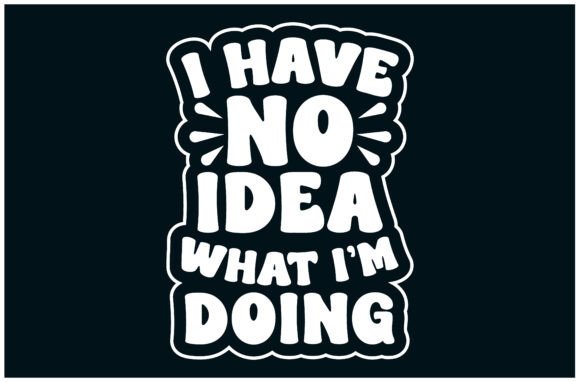
No Idea Tee: A Funny Clueless Shirt for Real Embroidery Projects
When I first downloaded the No Idea Tee, Funny Clueless Shirt design, I wasn’t sure what to expect. The name alone made me chuckle, but as a designer who regularly tests embroidery files for real-world use, I needed more than a clever phrase to justify adding it to my collection. I decided to run a full evaluation by stitching it out on a few different items—starting with a cotton tote bag, then moving to a baby onesie, and finally a classic crewneck sweatshirt. Here’s how it held up in actual embroidery scenarios.
First Impressions: Simple, Lighthearted, and Immediately Usable
The design immediately struck me as playful and approachable. It features a bold, all-caps phrase with a stylized scribble-like font that gives it a hand-drawn feel. The layout is centered, with no unnecessary embellishments, making it ideal for quick embroidery jobs where clarity and readability are key. There’s a certain charm in its simplicity—like it was made for someone who wants to add a bit of personality without overcomplicating the design.
Visually, it leans toward casual humor, perfect for boutique-style apparel, novelty gifts, or even as a subtle branding element for a lighthearted brand. The theme is unmistakably modern and fits well within the T-Shirt Designs category, though its adaptability makes it useful beyond just tees.
Real-Life Embroidery Test: From Tote Bags to Baby Clothes
I started with a 100% cotton tote bag, a common product for crafters and Etsy sellers. The No Idea Tee, Funny Clueless Shirt stitched out cleanly, with consistent satin and fill stitches. The text held its shape without distortion, and the overall density was balanced—not too tight, which is crucial for breathable fabric like cotton.
Next, I tried it on a stretchy baby onesie. I made sure to use a lightweight stabilizer and a smaller hoop. The design scaled down surprisingly well, though I noticed the letters started to lose a little crispness at smaller sizes. Still, it remained legible and cute, which is often the priority when embroidering baby items.
Finally, I stitched it onto a mid-weight sweatshirt. The texture of the fabric helped hide any minor stitch irregularities, and the design looked bold and intentional. It felt like a natural fit for casual wear—especially for small shop owners offering personalized sweatshirts with a humorous twist.
Where to Use with Caution
While the No Idea Tee, Funny Clueless Shirt performs well in many situations, there are a few cases where it needs careful handling. On dark fabrics, for example, the default thread colors may not stand out enough. I recommend checking the thread colors included in the file or adjusting them for contrast.
On curved surfaces like caps or curved corners of embroidered patches, the design might not flow as smoothly unless resized or repositioned thoughtfully. Similarly, on stretchy or textured fabrics, extra stabilizer and stitch density checks are necessary to prevent distortion or puckering.
Small hoop sizes can also be a challenge. The full phrase may not fit unless you scale it down significantly, which risks losing clarity. If you're working with tight hoop dimensions, consider using just a portion of the phrase or opting for a simpler font-based design instead.
Design Impact: Visual Appeal and Marketability
From a visual standpoint, this machine embroidery design adds immediate personality to any product. It’s especially effective for personalized gifts and custom apparel, where humor and relatability are part of the selling point. The clean layout also makes it easy to pair with other elements—like small icons or coordinating fonts—without overwhelming the piece.
For craft business owners and Etsy sellers, this design can help boost product value through its conversational tone. It’s the kind of phrase that customers might pick for themselves or as a gift, especially around holidays or special occasions. Its universal appeal makes it a solid addition to seasonal holiday embroidery collections or everyday small shop product lines.
However, because of its casual tone, it may not be suitable for more formal or professional branding. If you're creating commercial embroidery pieces for corporate gifting or business wear, this design might not align with your goals. But for casual wear, boutique items, and humorous gifts, it’s a winner.
Practical Notes for Embroidery Designers
Before using the No Idea Tee, Funny Clueless Shirt in a real project, here are a few practical tips based on my experience:
- Test the design on scrap fabric first, especially if you’re using it on a new fabric type or with a different machine.
- Check thread color contrast—especially on dark or patterned materials. You may need to tweak the colors for optimal visibility.
- Review stitch density to ensure it's appropriate for your fabric. Too dense can cause puckering; too loose can look unfinished.
- Confirm hoop size compatibility. If you're working with a small hoop, you may need to resize or simplify the design.
- Inspect small details after stitching. If any letters look compressed or distorted, adjust the settings before final production.
- Test it in black and white mockups to see how it reads without color. This helps when planning for neutral-toned items.
- Compare light and dark fabric backgrounds to determine if the design needs different color variations for each.
- Use proper stabilizer depending on the fabric type—cut-away for stretchy materials, tear-away for stable cottons.
- Check licensing before selling finished items or including it in digital product bundles. Always confirm commercial use rights.
Final Thoughts: A Versatile Addition to Your Design Library
Overall, the No Idea Tee, Funny Clueless Shirt is a solid, well-structured embroidery file that works well across a range of products. It’s especially useful for handmade product creators who want to add a touch of humor without sacrificing clarity or professionalism. Whether you're making personalized gifts, holiday embroidery, or small business merchandise, this design holds up under real stitching conditions and adds value to your finished items.
As with any digital embroidery file, it’s important to test and adjust for your specific use case. But once you do, you’ll find this design is more than just a joke—it’s a reliable, marketable asset for your embroidery projects.